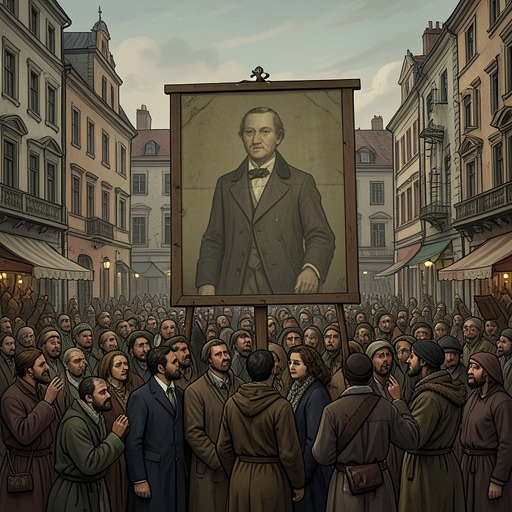
Ratification of the Fifteenth Amendment
News of the WorldThe Fifteenth Amendment is presented as a newly ratified national guarantee of voting rights for qualified men regardless of race, color, or previous condition of servitude. Its introduction through Jefferson Kyle Kidd’s newspaper reading gives the political milestone both a precise date and an uneasy local setting: the constitutional promise is clear, but the audience’s response and the surrounding disorder show that legal change does not settle how authority will be exercised or accepted.
Ratification and Its Stated Scope
Jefferson Kyle Kidd reads that the amendment has just been ratified on February 3, 1870. The report describes its protection as applying to all men already qualified to vote, without distinctions based on race, color, or previous condition of servitude. The qualification remains significant: the reading presents a prohibition on specified grounds for denying the vote, not a claim that every man is automatically qualified or that every obstacle to voting has disappeared.
By giving the date and the amendment’s scope in direct, declarative terms, the reading makes national political change part of the ordinary flow of news. The amendment reaches the audience not through a formal ceremony or legal proceeding but through a newspaper, spoken aloud in a temporary public gathering.
The Reading and Its Audience
Jefferson Kyle Kidd has put up his posters and changed into his reading clothes in a stable. Outside, hard rain makes the surroundings noisy, but he has a strong voice. He shakes out the pages of the Journal, reads the report, and then looks up from the text. His reading glasses catch the light as he leans over the lectern to explain that the amendment means Black men can vote.
The crowd’s muttering makes the announcement contentious rather than merely informational. Jefferson Kyle Kidd tells the listeners to stop, and his impatience gives the scene a sharp turn: the new constitutional guarantee is spoken aloud, but its reception is not presented as unanimous. The public reading therefore places the amendment’s stated equality beside a visible resistance to hearing what that equality entails.
Reconstruction and Uneven Authority
Other encounters in the novel show how political rights and administrative power could remain unsettled in Texas. When an officer asks Jefferson Kyle Kidd for proof of a loyalty oath, the requirement is tied to whether he voluntarily aided the Confederate Army; he says that he did not. The exchange shows the continuing reach of postwar rules into ordinary travel, even as their application depends on officials and documentary proof.
In Erath County, men declare that supporters of Davis will not be admitted. They explain that there is no sheriff, justice of the peace, mayor, or commission: former officials have been removed, and no replacements have been sent. Their claim to authority does not alter the amendment’s text, but it places its national promise within a landscape where local administration has broken down and competing groups assert control. The novel thus distinguishes the formal expansion of political rights from the fractured institutions through which rights and rules had to be lived.
Significance in the Narrative
The amendment’s reading is a compact encounter between constitutional language and public response. Its date and stated protection give the audience a measure of the scale of change; the muttering, loyalty-oath requirement, and absence of local government reveal a less orderly process on the ground. The scene does not claim that ratification immediately resolves the political conflicts around it. Instead, it makes the act of announcing the new guarantee consequential in itself: the words enter a room where their meaning is understood, challenged, and bound up with the unstable authority of Reconstruction-era Texas.